A personal reflection on snoring, smoking, missiles and our one shared planet
The rainforest wait that started it all.
I have been stuck at home for almost six weeks, and it all started because of a bird in Indonesia!
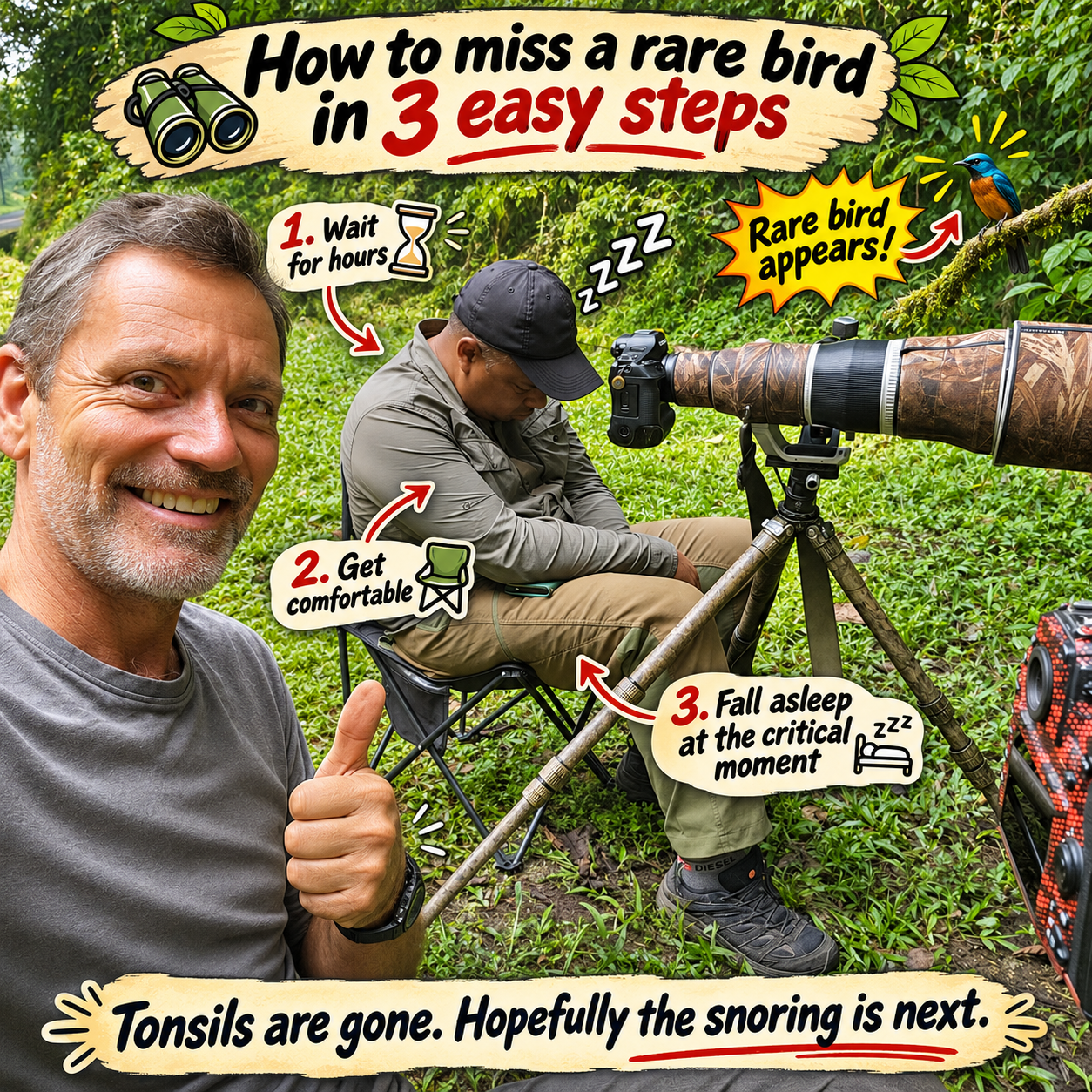
On my recent trip, we spent hours waiting for a particularly rare bird to appear. As any serious bird photographer knows, you can spend half your life waiting for a bird that gives you approximately three seconds to photograph it.
Well, the bird finally appeared.
Unfortunately, I was fast asleep, snoring away like a chainsaw in the Indonesian rainforest! 😂
Apparently, my snoring had become quite a problem, and I was advised to have my tonsils removed to help with my obstructed airway.
For anyone considering having their tonsils removed as an adult, I can assure you this is medieval torture disguised as modern medicine!
Today is day nine after surgery. I can finally eat some solid food. I have lost 6 kg, although I would not recommend this particular weight loss programme!
Being unable to return to the forest has been depressing. But lying around at home with far too much time to think, my mind wandered to something considerably more serious.
I started thinking about how spectacularly stupid we humans can be.
Let me explain.
I first travelled on an aeroplane in the mid 1990s. I remember ashtrays built into the seats and my father being able to walk towards the back of the aircraft for a cigarette.
Imagine that!
Hundreds of passengers inside a pressurised metal tube, thousands of metres above the ground, happily breathing cigarette smoke!
The airlines even had separate smoking and non-smoking sections.
Apparently, cigarette smoke was expected to understand airline seating arrangements and stay within its designated rows! 😂
Australia banned smoking on domestic flights in 1987, but international flights operated by Australian airlines were not completely smoke-free until 1996.
Today, we know the consequences of passive smoking. The World Health Organization estimates that secondhand smoke still kills more than 1.6 million non-smokers every year.
Eventually, we accepted a simple principle.
Your freedom to smoke does not give you the right to poison everyone else breathing the same air.
Now apply that logic to the world today.
Turn on the news.
Some genius launches a missile costing millions of dollars. Another genius launches an equally expensive missile to intercept it.
Both explode, and everyone congratulates themselves on a successful military operation.
Fantastic! Millions of dollars spent destroying expensive machinery in mid-air.
And apparently, this is what we call national security! 😂
But hang on a minute.
Are we not all passengers on the same planet?
If I cannot smoke a cigarette near certain public buildings because other people might inhale the smoke, why can governments launch weapons that pollute our shared atmosphere, destroy habitats and contaminate land and water?
Perhaps we need designated missile launching areas.
“Attention world leaders: Missile launching is strictly prohibited within 10 million light years of Earth. Please proceed to the designated smoking area in another galaxy.” 🚀😂
Perhaps we should send the politicians along with their missiles. That should give the rest of us some peace and quiet!
Jokes aside, the environmental consequences of warfare are serious.
Manufacturing weapons, operating military equipment, burning fuel, destroying forests, contaminating rivers and rebuilding devastated cities all carry enormous environmental costs.
One scientific study estimated that the world's militaries and their supply chains account for approximately 5.5% of global greenhouse gas emissions. It is an estimate because military emissions are notoriously poorly reported.
I am not questioning a country's right to defend itself, nor pretending that every conflict is simple.
But I have one question.
Who pays for the environmental damage?
Perhaps we should introduce an environmental damage levy.
Missile: $1 million.
Planetary environmental levy: $100 million.
Please pay before launch. We accept Visa, Mastercard and international bank transfers. 😂
Of course, the figures are imaginary. Actual damage would need to be assessed.
But why should billions of innocent people, future generations and wildlife bear environmental costs they never agreed to?
And who would send that invoice?
That is the real problem.
A small country challenging a powerful nation can face sanctions, tariffs, diplomatic isolation and other consequences. Even individuals speaking out can face repercussions.
We have international institutions, agreements and endless conferences, yet holding powerful countries accountable remains extraordinarily difficult.
We have become clever enough to invent weapons that travel faster than sound, but apparently not wise enough to protect the only planet on which those weapons are useful.
And warfare is only part of the problem.
Consider the devastating floods and mountain disasters in Nepal, where people have lost their homes, livelihoods and lives. Climate change is increasing certain environmental risks, although not every disaster has the same cause.
Many of those suffering have contributed very little to the problem.
Once again, innocent people are breathing somebody else's smoke.
A friend of mine who works in the Arctic recently made an observation that has stayed with me.
Nature is like a house of cards.
Remove one card, and the structure remains standing.
Remove another, and perhaps nothing happens.
Keep removing cards, and eventually the whole thing collapses.
The frightening part?
We do not know which card will bring everything down.
As someone who has travelled through forests, wetlands, mountains and oceans photographing wildlife, I find this deeply disturbing.
Birds disperse seeds. Insects pollinate plants. Forests regulate water. Healthy soils produce our food. Oceans support entire ecosystems.
We are not separate from nature. We are completely dependent on it.
According to the landmark global assessment by IPBES, approximately one million animal and plant species are threatened with extinction, and extinction rates are already tens to hundreds of times higher than the long-term natural average.
Think about that.
We are destroying the very systems that produce our food, clean our water and make civilisation possible.
Meanwhile, we congratulate ourselves on being the most intelligent species on Earth.
We can send spacecraft millions of kilometres into space, but apparently cannot work out how to live peacefully on the one planet we already have.
Earth is approximately 4.54 billion years old.
Modern humans have existed for only about 300,000 years.
That is barely a blink in Earth's history.
Yet in that short time, we have developed the ability to alter the climate, destroy ecosystems and threaten countless other species.
People often say, “The planet will survive.”
They are probably right.
Earth survived asteroid impacts, catastrophic volcanic eruptions and multiple mass extinctions.
The planet does not need us. We need the planet.
If humanity disappears one day, Earth will continue orbiting the Sun.
No farewell ceremony. No memorial plaque. Not even a final Facebook post!
I do not know whether humanity will become extinct in 300 years, 3,000 years or far beyond. Nobody knows.
But we do know that environmental damage is happening now, and some losses are irreversible.
Perhaps our greatest weakness is that we struggle to care about consequences beyond our own lifetimes.
We worry about the next election, the next financial quarter, the next holiday and the next smartphone.
But what about the next hundred years?
We seem determined to win every war, every argument and every economic competition, even if we destroy the very things that make winning worthwhile.
I have travelled to many corners of this extraordinary planet. The more I see, the more convinced I become that nature is infinitely more fascinating and valuable than anything we have manufactured.
We do not need another thousand speeches about saving the planet.
We need accountability, protection of habitats, honest environmental reporting and rules that apply to powerful nations as well as weaker ones.
Above all, we need to recognise that environmental destruction does not respect national borders.
We eventually understood that smoking inside an aeroplane was unacceptable because we were all breathing the same air.
Perhaps it is time to realise that the entire planet is one enormous aeroplane.
There are no emergency exits, no replacement aircraft and no second planet waiting at the arrival gate.
Anyway, those are the thoughts of a slightly miserable bird photographer, nine days into recovering from tonsil surgery, desperately missing the forest and surviving on a rather uninspiring diet!
Hopefully, when I return to Indonesia, I will no longer snore like a malfunctioning diesel engine and might stay awake long enough to photograph the bird I travelled halfway around the world to see! 😂🐦
But there is one final thought I want to leave with you.
I missed one rare bird because I was asleep.
How many warnings about our planet are we all missing because we are still asleep?
At least I have had my tonsils removed to address my problem.
What is humanity prepared to change to address its own?
Sources and further reading
World Health Organization: Tobacco fact sheet — https://www.who.int/news-room/fact-sheets/detail/tobacco
IPBES: Global Assessment on Biodiversity and Ecosystem Services — https://www.ipbes.net/news/Media-Release-Global-Assessment
Scientists for Global Responsibility: Estimating the military’s global greenhouse gas emissions — https://www.sgr.org.uk/publications/estimating-military-s-global-greenhouse-gas-emissions
Tobacco in Australia: Smoke-free environments and legislation — https://www.tobaccoinaustralia.org.au/chapter-15-smokefree-environment/15-7-legislation
Share this article
A PRIVATE CONVERSATION
Share your thoughts
Have a question or a perspective to share? Send me a private message about this article. Your message and contact details will not be published.